Every fall and winter, branded hoodies become one of the most requested items for corporate gifts, team gear and event apparel. Getting an order right is not just about picking a color and slapping a logo on the front. To ensure your investment gets worn instead of buried in a closet, you need to understand current fit trends, popular fabrics, practical size distribution and realistic imprint placement.
To cut through the guesswork, we reviewed four full seasons of production order data (spanning October through February from 2022 to 2026, across hundreds of styles and dozens of top brands).
Here is what the actual numbers tell us about what recipients want, how to order smarter and how to make your brand look sharp.
1. The Pullover Dominates
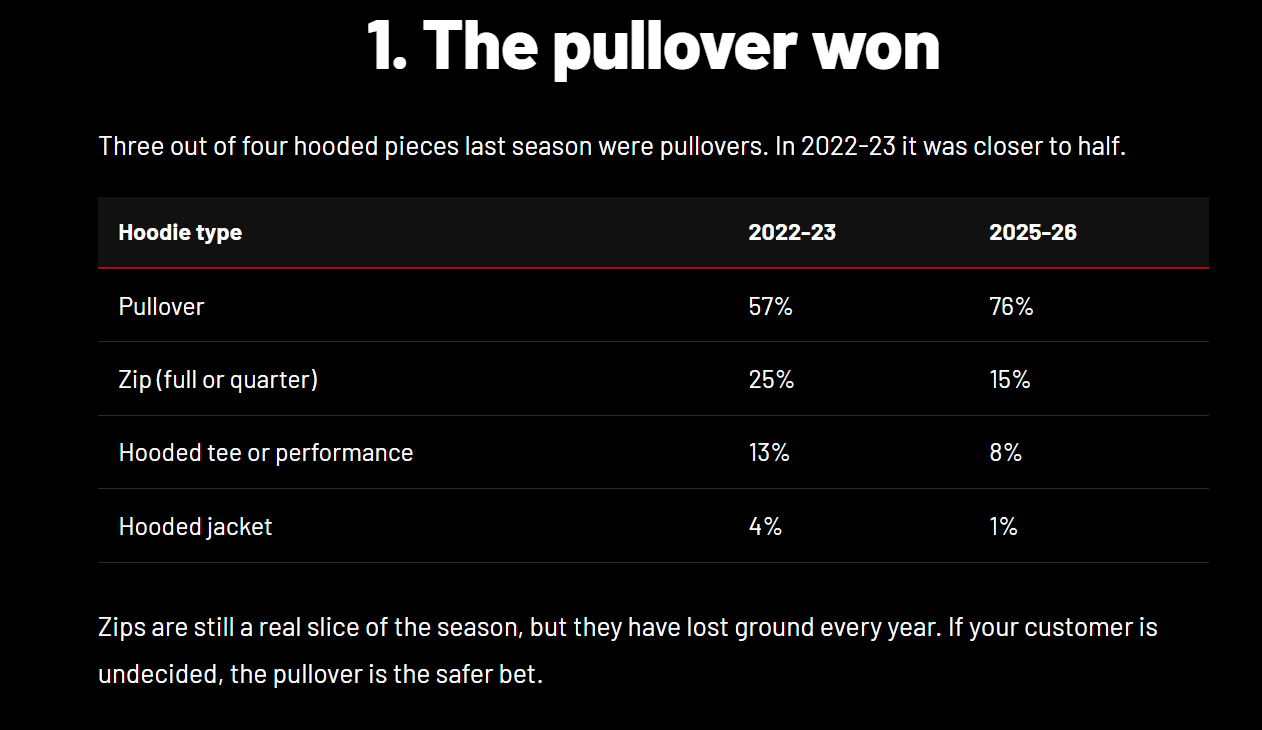
If you are torn between a classic pullover or a full zip, the numbers show a decisive favorite:
-
76% of hooded pieces ordered are pullovers.
-
Full-zip and quarter-zip styles accounted for only 15% of orders, down from 25% just three years ago.
Unless your team explicitly needs a zip front for easy on-and-off layering over uniform collars, the pullover is your safest, most universally appreciated bet.
2. Basic Workhorse vs. Retail Softness
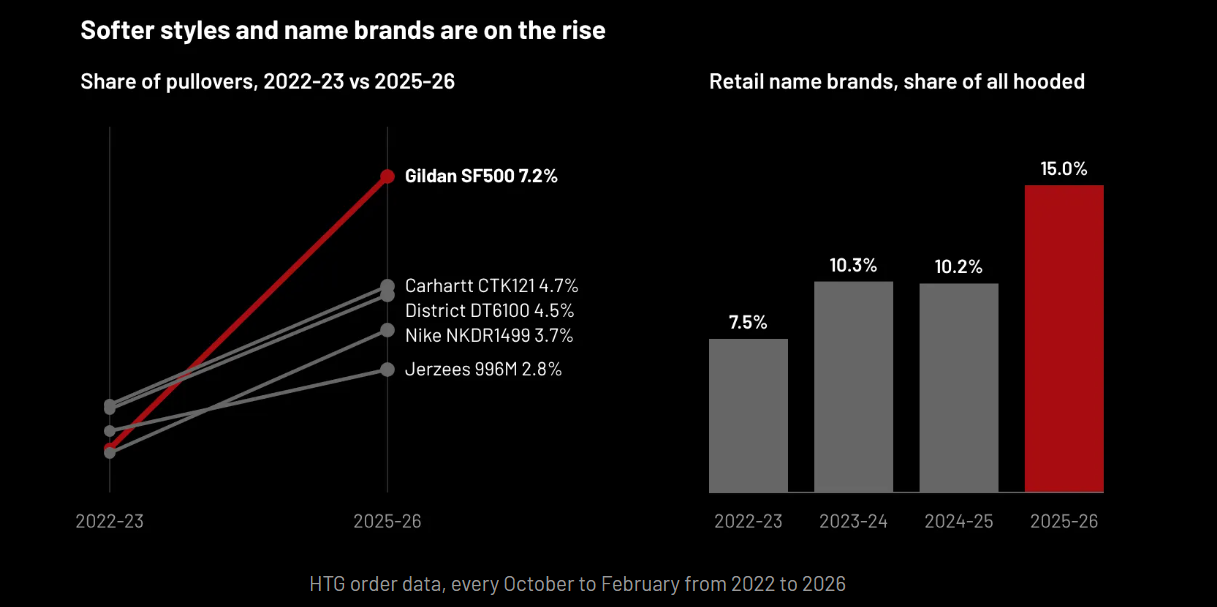
For years, the standard heavy blend fleece (such as the classic Gildan 18500) carried the category on sheer value and durability. While it remains a reliable, cost-effective option for large-scale giveaways, client demand has shifted noticeably toward better hand-feel and retail styling:
-
Midweight, ring-spun softness: Styles like the Gildan Softstyle Midweight and District fleece grew dramatically over the past four seasons. Recipients prefer a softer, slightly lighter drape they can wear comfortably indoors at their desks.
-
Co-branding with retail names: Orders featuring retail-recognized brands like Carhartt, Nike, Marine Layer, New Era and The North Face have doubled, jumping from 7.5% to 15% of all orders.
Recommendation: For high-volume campus events or warehouse staff, classic heavy blend fleece remains budget-friendly and durable. For client gifting, new hire kits or executive teams, stepping up to a retail-grade or ring-spun midweight fleece delivers far higher perceived value and daily wear.
3. The Core Colors (and Emerging Tones)
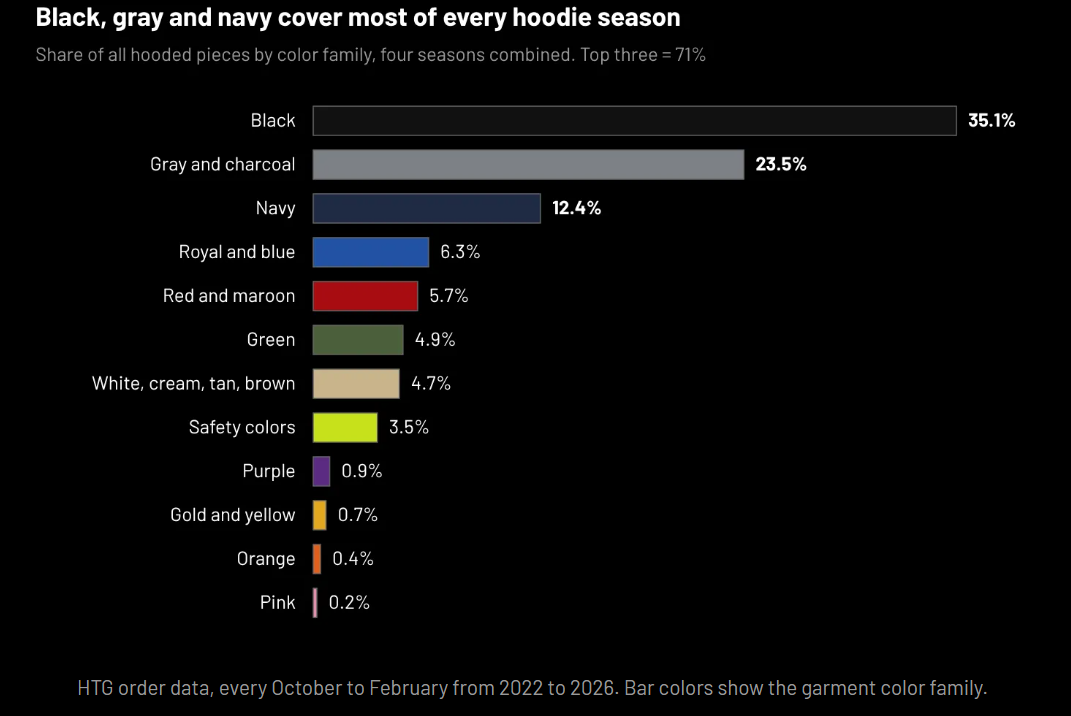
When ordering custom apparel, neutrals always win the day:
-
Black, gray and navy make up 71% of all hoodie orders. Black alone accounts for over 35%. If you want guaranteed adoption across a diverse team, stick to these three core foundations.
-
On the rise: Earthy tones (such as military green, olive, cream, tan and warm browns) have grown significantly, climbing from 2.5% to 6.5% of total volume.
-
Safety colors: Hi-vis safety orange and neon green account for 3.5% of total orders—more than purple, gold, orange and pink combined—serving outdoor job sites and safety-first field crews.
4. Build Your Size Run Bigger Than You Think
The most common mistake marketing teams make is ordering a standard bell curve centered around Medium. In hoodies, people overwhelmingly prefer a relaxed, roomy fit:
-
Large (28.4%) and XL (24.9%) make up more than half of all adult hoodie orders.
-
XL regularly outsells Medium.
-
Sizes 2XL and larger account for 17% of total orders.
If you are putting together an order for 100 adult hoodies and do not yet have specific employee sizes gathered, use this data-backed breakdown as your blueprint:
| Size | Suggested Qty (Per 100 Pieces) |
| XS | 1 |
| Small | 9 |
| Medium | 20 |
| Large | 28 |
| XL | 25 |
| 2XL | 12 |
| 3XL | 4 |
| 4XL+ | 1 |
Note: True youth sizing accounts for under 2% of annual corporate volume, meaning hoodie projects are overwhelmingly adult-focused.
5. Artwork Placement: A Hoodie Is Not a T-Shirt
A hoodie comes with unique functional elements—a front kangaroo pocket and an overhanging hood—that require careful art placement:
-
Front Imprint: The kangaroo pocket reduces your printable vertical area by roughly 6 inches compared to a standard tee. An adult front print should run roughly 12" wide by 9" high, placed 2" to 4" below the collar seam so the hood cords and pocket do not crowd the design.
-
Back Imprint: To prevent the draped hood from blocking your company logo or message, the back imprint must start at least 4" down from the collar seam. A standard back footprint runs around 12" wide by 15" high.
-
Youth Pieces: If your project includes youth sizes, never use the same screen size as adult garments. Adult art will run directly into the pocket on a youth hoodie. Youth pieces require a separate, scaled-down screen (typically 9" x 7" front, 10" x 12" back).
Quick Checklist for Your Next Project
-
Choose Pullovers for general team engagement unless your specific workflow demands a full zip.
-
Upgrade the Fabric to ring-spun fleece or a recognizable retail brand if you want clients and team members wearing it outside the office.
-
Anchor in Neutrals (Black, Gray or Navy) or explore deep military greens and warm earth tones for a modern look.
-
Order Roomy Sizes—skew your totals toward Large, XL and 2XL to accommodate modern hoodie fits.
-
Adjust Art for the Garment—keep front prints centered above the kangaroo pocket and push back prints down so the hood never covers your brand.
Ready to plan your next apparel run? Reach out to Geek Tech Branding today to find the perfect fleece, dial in your sizing splits and ensure your logo looks sharp from day one. Whether you are outfitting your team, planning a major event or sending high-end client gifts, we will guide you through the best styles and handle all the decoration details.
Data and production metrics courtesy of HighTechGrafix.
